THE LA QUARTET By James Ellroy
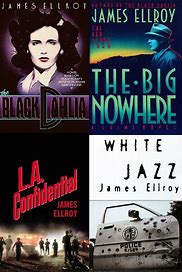
Sometimes we just like to engage in a medium that provides comfort. Not just the medium for the medium’s sake but a particular show or movie. That’s the reason why I’ve seen the same episode of Cheers where Sam Malone blows up his own bar to win a prank war, fifty times and watched Schindler’s List once. Poor example. I admire, appreciate and love Children of Men but I’d rather watch Weekend at Bernie’s multiple times over the Cuarón classic. And that’s also why I read certain books over and over.
My first review isn’t one book, it’s four. James Ellroy is the type of writer I love to explore with his characters and the places he puts them but I’m fairly certain I wouldn’t want to be friends or even hang with Ellroy. Maybe that’s what brilliance is all about, I wouldn’t know. The LA Quartet began a literary journey that spanned from the 40s and 50s and led to his Mob Underworld Trilogy which concluded in the 70s. Two of the Quartet have been adapted to movies; the sublime LA Confidential and the dreadful The Black Dahlia.
The four books that make up the Quartet are: The Black Dahlia, a fictional look at the investigation into Elizabeth Short’s murder; The Big Nowhere, delving into the ‘Red Scare’ alongside a brutal homosexual murder; LA Confidential, a wild ride into Hollywood with a nudge and wink at Disney and White Jazz, my favorite and most difficult to categorize.
The Black Dahlia
Don’t let the crap Brian Depalma vomited onscreen distract you from a top notch, hard boiled thriller. The tale of two cops, Bucky Bleichart and Lee Blanchard, on the tail of the Black Dahlia murderer (s), this was Ellroy’s first true effort into the darkness of Noir. To be fair, Brown’s Requiem and Clandestine are interesting efforts and Ellroy’s potential is etched on the pages of those books but Dahlia is his first realization of what he could accomplish. Bleichart and Blanchard dig into the true heart of darkness and the heart’s are aplenty. It’s a dazzling twist of a tale.
The Big Nowhere
The Big Nowhere extended Ellroy’s entrance into the darkness of Los Angeles and, in many ways, is the true introduction of the Quartet. Dahlia feels estranged from the other three novels in that the only true thread is Los Angeles. Utilizing the ‘Red Scare’ and HUAC as the backdrop, the story centers on the relationship of three officers: Danny Upshaw, Mal Considine and Buzz Meeks.
Characters abound in this dark tale and Buzz Meeks is a hoot (and his story drips into LA Confidential) but the story and the novel belongs to Dudley Liam Smith. Dudley must be Ellroy’s favorite character to write (Smith appears in six of Ellroy’s books). Amoral to a spectacular degree, Smith is the embodiment of evil, utilizing his Irish Catholic charms to woo potential victims into his web of deceit. A villains’ villain, Smith is as captivating as he is horrifying and his character weaves through the Quartet like a Wraith.
LA Confidential
LA Confidential is the big, bad boy of the group, not only in length but also scope and time. It’s magnitude is ambitious. Following three officers of different intelligence, strength and moral turpitude, LA Confidential is probably Ellroy’s best character study. Ed Exley, Jack Vincennes and Bud White battle with and against each other with Dudley Smith in the backdrop. The terrific film adaptation is very different than the novel but the feel and texture is spot on. In fact, when I read the book now, I see Russell Crowe as White, Guy Pearce as Exley and James Cromwell as Dudley. I don’t see Kevin Spacey as Vincennes because … well, just because.
For as long a book as it is, it is a lightning race down the track to a wild ending. The story covers years of these men’s lives and sees them through their own destructions and revivals. And it is a delight to see the world of Disney skewered in such a way. A must read.
White Jazz
Which brings us to White Jazz. I was going to do an entire review of just White Jazz but I felt it was too esoteric. The novel ties up the loose ends of Exley and Smith through the eyes of the fascinating David Klein (and also introduces Pete Bondurant, a major player in the next few books) but to me, the key to the book is the style. This is Ellroy’s first foray into the style that would make him unique. ‘White Jazz’ refers to the way the book is written and how the main character weaves himself in and out of the world with a staccato all of his own. It takes a chapter or two to pick up the notes but once you do, the symphony rings.
Ellroy perfected his style in the following novel, American Tabloid, which is the first of the Mob Underworld Trilogy, but to me, White Jazz plays alongside American Tabloid as his two best works. George Clooney and, later, James Franco both attempted to adapt this book to film but I just don’t see how that’s possible. I’ve always said the Mob Underworld Trilogy would be best served as an extended limited series and I also think that’s the only way White Jazz could be brought to the screen. Make the entire LA Quartet into an extended anthology or limited series. There’s so much material. These books don’t necessarily need to be read in order but I would suggest as such. You can pick up any of the books and get wrapped up in the story but starting from the beginning is more satisfying.
Now I know, Ellroy is not everyone’s taste and there is a level of misogyny that is uncomfortable. But to me, The LA Quartet captures a time and place that is gone (for the better) but still intrigues. I will often drive through the streets of the City of Angels and hear Dave Klein narrate from White Jazz as I turn from Wilshire onto La Brea.
 Where the 91 Ends