LONE STAR (1996) Dir. John Sayles
“Forget the Alamo” Sheriff Sam Deeds
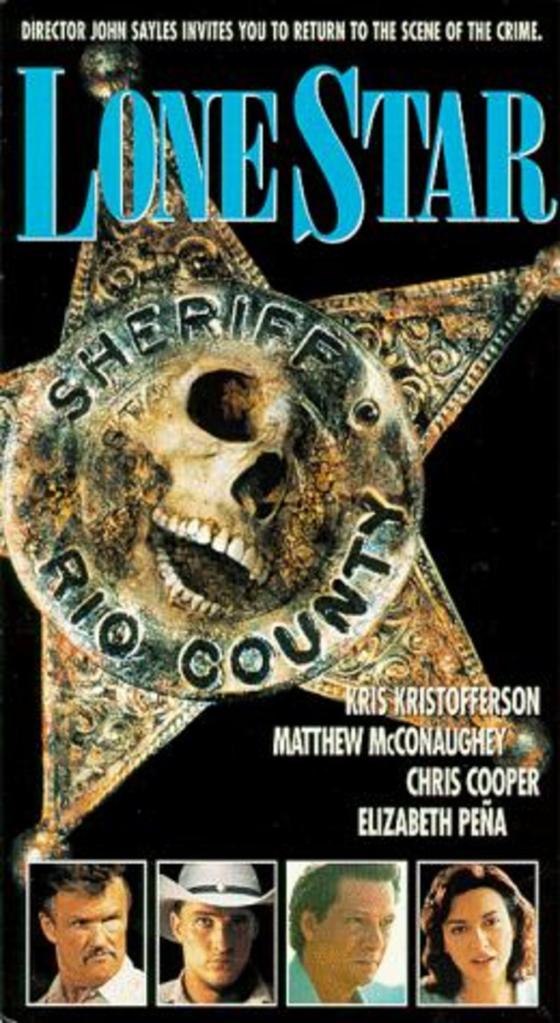
It’s hard to explain the importance of the Angelika Film Center to me, during my time in New York City. In 1996, I was living and working in the South Bronx, writing about the conditions of that borough as I worked toward my college degree. I would take the train to the Angelika and see ‘indie’ films. I saw Stealing Beauty with a very young Liv Tyler and Manny and Lo with an even younger Scarlett Johansson. But the highlight of my Angelika travels was Lone Star.
To understand Lone Star is to understand the brilliance of John Sayles, one of the 90s Indie stars. His directorial work is remembered by cinephiles but his name doesn’t resonate with the modern film crowd. He is probably most remembered for directing and acting in 8 Men Out, a solid movie about the 1919 Black Sox World Series scandal. A prolific writer, Sayles wrote the original draft of ET (then titled Night Skies) and did touch-ups on movies such as Apollo 13. Raising his own money to shoot his films, he had a great run in the 90s with terrific movies such as Limbo, Men with Guns and, the outstanding City of Hope. His earlier film Matewan is also a personal favorite. Great movies, but Sayles hit the jackpot with Lone Star.
Ostensibly a crime drama, Lone Star delves into the life of a dying Texas, border town, Frontera, whose local military base is closing. The closing of the base is a death knell to the small town and a hint of fear resides in Frontera. Sheriff Sam Deeds (a strong Chris Cooper) investigates the recently discovered skeletal remains of a murder victim. Learning it is the remains of a former sheriff, ‘Big’ Charlie Wade, Deeds focuses his investigation on his father, the late sheriff who replaced Wade. His father, Buddy Deeds (in one of Matthew McConaughey’s first roles) is a local Frontera legend, so much so, they erect a statue in his honor.
The murder investigation is the Macguffin that pushes the plot but the film covers social, racial, generational and familial issues that are handled with such diction and care it’s almost as if you’re sitting in a college classroom watching Texas history unfold. Cross cultural and cross generational threads intersect this story and break down tropes that are so often muddled in lesser films.
Sayles is so good at handling generations of race and family secrets. In City of Hope, his focus was on city politics and local graft but in Lone Star he takes a big bite out of so much more. Only a director capable, and willing, to raise his own capitol is able to cover issues with such depth with no fear of recriminations.
The great Kris Kristofferson plays Big Charlie Wade and is one of the most evil sons of bitches I’ve ever seen in a film. His depiction of Wade illustrates an Old West that is based more in reality than myth. His sheriff is the sheriff of lynching’s and murders and a side of the ‘good ol’ West’ that is ugly and not romanticized. It is a side of the movie that displays what it meant to be a Mexican or African-American in the southwest. Sayles offsets the past with the progress of the present. Mexican-Americans and blacks are business owners and civic leaders in the new Frontera but only one generation removed from the Charlie Wade’s of the world. Lone Star tells a story of secrets long hidden. When Wade’s body is unearthed, it dredges up more than just a murder mystery but long hidden familial and civic secrets of Frontera. It’s those types of secrets that America is built on and Sayles is a master at peeling the onion.
When I said watching Lone Star was like sitting in a classroom, it was a compliment. To this day, I recall, fondly, sitting in the Angelika as Lone Star unfolded before me. It is a cherished memory. My best advice would be to sit in a comfy chair and let Sayles tell you a tale of Americana. “Forget the Alamo”. Yes, maybe the victors write the histories but the defeated still have their shared history.
 Where the 91 Ends